
The Truth About Vancouver’s Underground Tunnels
Ask around Gastown or Chinatown long enough and someone will tell you a story about a tunnel running beneath the street: an old bootlegger’s passage, a forgotten rail line, an underground network built to dodge police raids. Vancouver has one of the most persistent urban-legend traditions in Canada when it comes to what’s supposedly buried below the pavement.
Some of it is true. A lot of it isn’t. Here’s what’s actually down there, what’s myth, and how you can experience the real history for yourself.
So, Do Vancouver Underground Tunnels Actually Exist?
Yes, but not in the sprawling, connected “secret city” form that legend suggests. What actually exists beneath downtown Vancouver is a patchwork: a handful of genuine engineered tunnels, some short private passageways under old buildings, and a great deal of exaggeration layered on top by decades of retelling.
The confusion makes sense. Vancouver’s earliest neighbourhoods, Gastown and Chinatown, have always had a reputation for vice, secrecy, and things happening out of sight. That reputation is exactly the soil urban legends grow in.
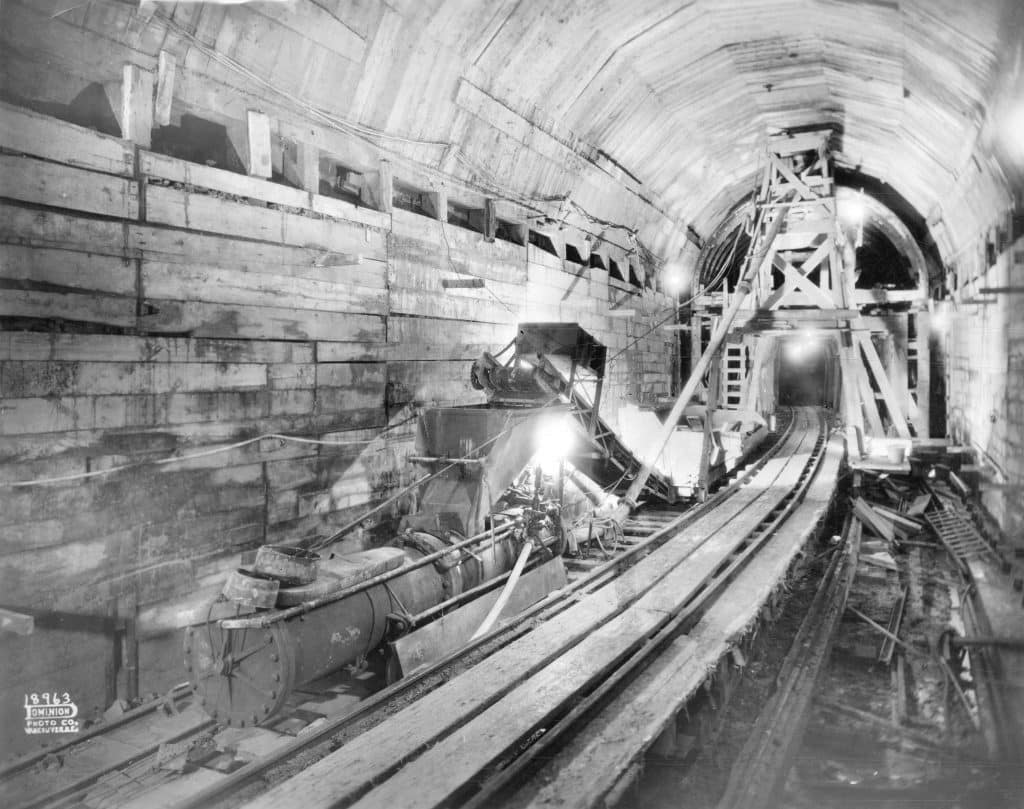
Progress photograph for the Northern Construction Company. Photograph shows the semi-completed Dunsmuir Tunnel. Image includes cement gun, delivery pipe, and concrete form. 1930-1933. City of Vancouver Archives Item : 152-6.07
The Real Tunnels Beneath Vancouver
The Dunsmuir Tunnel
The most significant, verifiable tunnel under the city is the Dunsmuir Tunnel, a rail tunnel running beneath Dunsmuir Street. It was originally built to connect the Canadian Pacific Railway’s railyards on Burrard Inlet and False Creek and opened in 1933. In some sections it sits only about six metres below the surface. Today, it carries SkyTrain’s Expo Line, and Burrard and Granville stations are actually built inside the tunnel itself. Because the tunnel was only wide enough for a single track, engineers had to get creative: a superstructure was built inside so the westbound and eastbound tracks could run one above the other, giving those two stations their unusual split-level platforms.
The Old Canada Post Tunnel
Beneath the historic Post Office building on West Georgia (now redeveloped as “The Post”) begins a stretch of tunnel that’s become one of the city’s favourite “secret” spots to whisper about. The roughly 730 metre tunnel was built by the Post Office Department back in the 1950s to transport mail from the Post Office’s central sorting branch to trains at the CPR railyards. Soon after the tunnel was finished, Canada Post began using trucks to transport mail and so it was only used for its intended purpose for a few years.
The tunnel did find a strange second life as a filming location for Hollywood productions and, for a time, as a rented-out Halloween attraction, before eventually being filled in over safety concerns. It isn’t open to the public, and for good reason: old, unmaintained infrastructure like this poses real structural and security risks.
Steam Tunnels and Underground Connections
Smaller, more mundane tunnels exist too. Examples include steam-supply tunnels connecting older institutional buildings (UBC’s campus has some) and underground doorways in older buildings that once connected to link businesses like bathhouses, saloons, or hotel annexes. These are functional, small-scale, and nothing like the citywide network of legend. An example is the building at 158 East Pender in Chinatown, once home to the famous Sai Woo Chop Suey restaurant. The basement still contains a connecting portal to the basement of the building immediately to the west.
The Secret Code of Gastown’s Purple Tiles
If you walk the pavements of Gastown or Chinatown, you’ll inevitably step on patches of small, purple glass tiles set into the concrete. Local lore has a field day with these. Depending on who you ask, the purple glass is a covert marker for underground brothels, Prohibition-era speakeasies or “blind pigs”, or hidden entrances to the mythical tunnel network itself. It’s a great story. It’s also pure fiction.
Those tiles are “vault lights,” and their real purpose was entirely practical. These heavy glass prisms were installed in the pavement to catch sunlight and refract it down into the subterranean storage rooms, bathhouses, and boiler rooms below. And that signature purple colour? It wasn’t a deliberate signal to bootleggers. Early manufacturers used manganese dioxide in the glass production process. Over a century of exposure to ultraviolet radiation from the sun has chemically altered the glass, turning it a deep amethyst. The tiles don’t map out a secret criminal underworld, they’re just 120-year-old lightbulbs with a sunburn.
The Chinatown Tunnel Myth, Busted
No Vancouver underground tunnels story gets repeated more than the one about a hidden network beneath Chinatown, supposedly used to dodge police raids on gambling dens and opium houses during the early 1900s. It’s a compelling story. It’s also not true. As mentioned, some of the buildings in Chinatown did once (and in some cases, still do) connect underground; it’s entirely possible these connecting doorways may have been used on occasion by gamblers, opium users, or just regular Chinese people fleeing the frequent police raids of the time.
It’s a major overreach, though, to equate the entirely legal construction of basements in early Chinatown with a network of secret tunnels. Similar myths persist in New York, Portland, and Victoria. It’s hard not to feel a tinge of racism in the depiction of historic Chinese communities as rife with so much criminal activity that residents built warrens of underground tunnels to hide from the authorities. The reality was that the Chinese community in Vancouver, and in other cities around North America, was often targeted by the police and treated harshly by government officials and the courts. Basements may have simply provided convenient escape routes during police raids.
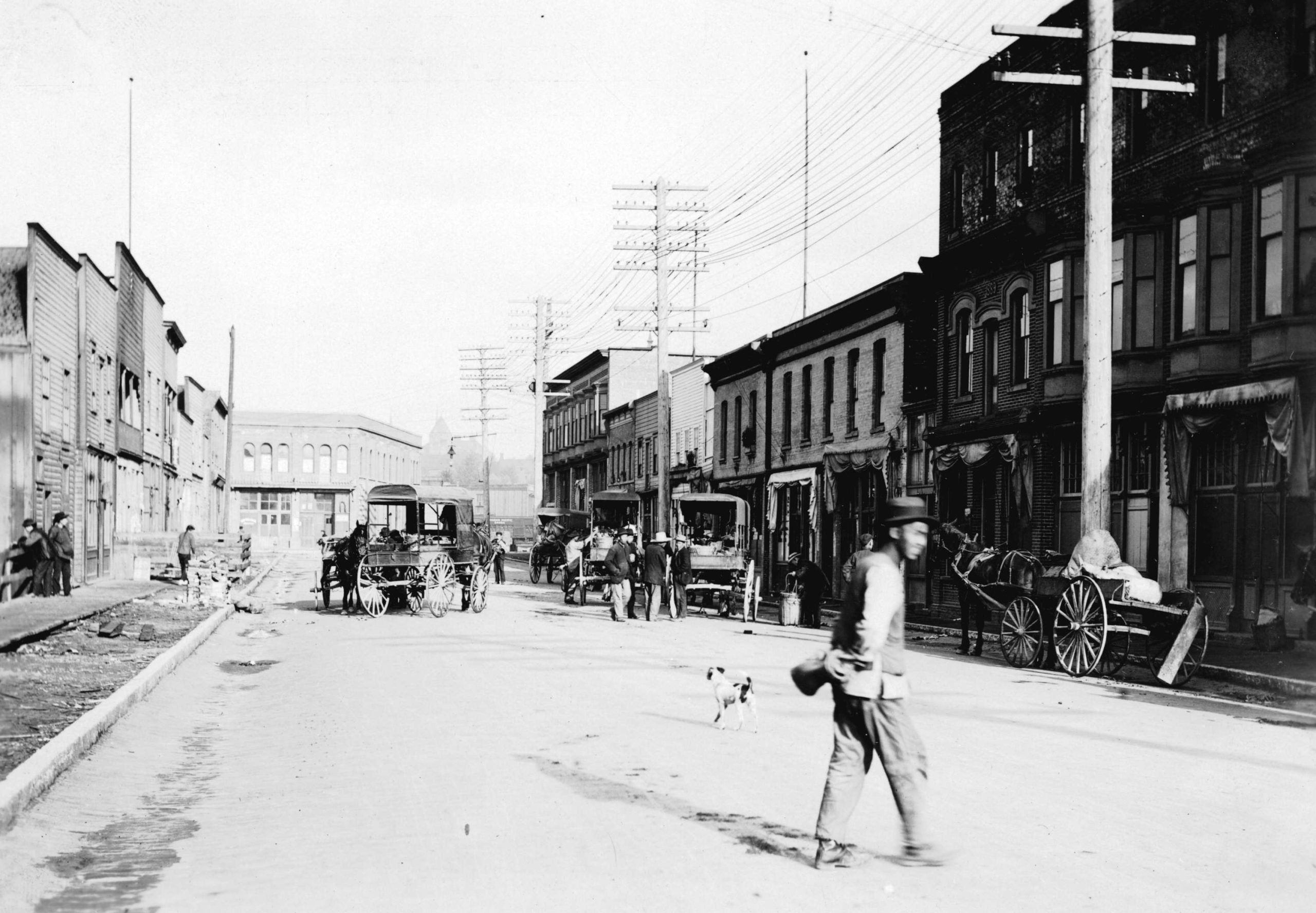
Dupont Street (later Pender Street), 1906. Credit City of Vancouver Archives.
What About the West End?
The Chinatown myth gets most of the attention, but the West End has its own tunnel folklore. We’ve had people on our walking tours swear up and down that “their grandfather once walked the secret tunnel from Gabriola down to English Bay.” Rumour has it B.T. Rogers, the founder of the B.C. Sugar Refinery, had a tunnel secretly built beneath Davie Street from his Gabriola Mansion all the way down to Maxine’s Beauty School on Bidwell Street, and then from there several blocks further to English Bay. Supposedly, old Rogers was a frisky fellow who would pay nocturnal visits to the young ladies at Maxine’s, and then during Prohibition have booze smuggled up from English Bay.

It would have been an astonishing engineering project to construct a tunnel going several blocks beneath a main Vancouver street and then on to English Bay. It’s ludicrous to think Rogers could have commissioned such a project without people finding out. Not to mention, Maxine MacGilvray ran an entirely legitimate business and there isn’t any evidence she ran a brothel. It’s also worth noting that while we had Prohibition here for four years during WW1, it wasn’t hard to get liquor via doctor’s prescription during that time. Constructing a lengthy tunnel to acquire liquor would have been completely unnecessary.
Incidentally, if you want to find out more about how Vancouver fared during Prohibition, do check out our Forbidden Vancouver Tour!

Gabriola Mansion. Credit: The West End Journal
Is There a Vancouver Underground Tunnels Map?
Not really, and that’s part of why the mystery persists. The genuine tunnels (the Dunsmuir rail tunnel, the sealed Canada Post tunnel) are individually documented in engineering and transit records, but there’s no single, publicly available map stitching together a “Vancouver underground tunnel network,” because no such connected network exists. Most of what circulates online as an “underground tunnels map” is really a mix of rumoured routes, forum speculation, and creative reconstructions rather than verified survey data. If you’re picturing a Reddit-style diagram with a web of tunnels crisscrossing Gastown and Chinatown, treat it as folklore, not fact.
How to Actually Experience This History
Reading about underground Vancouver is one thing, walking the streets above it, with someone who knows which stories are true, is another. You won’t find a literal Vancouver underground tour that takes you beneath the pavement (most of what’s down there is structurally unsafe, privately owned, or simply sealed off), but you can walk directly over the real history with a guide who separates fact from legend as you go.
Forbidden Vancouver’s walking tours are built around exactly this kind of hidden-in-plain-sight storytelling. On The Forbidden Vancouver Tour, you’ll walk Gastown’s historic streets and spot the century-old purple sidewalk tiles that mark real underground areaways and long-gone basement bathhouses, while hearing how Prohibition pushed the city’s drinking culture underground in the first place.
The Bottom Line
Vancouver underground tunnels are real, but they’re far more modest and far more scattered than the legends suggest. There’s a working rail tunnel under Dunsmuir Street, a sealed-off post office tunnel, and a handful of small basement passageways. There’s not a hidden citywide network built for smuggling and secrecy. The Chinatown tunnel network in particular is a myth, born from police frustration and old prejudices rather than architectural fact.
What is true is arguably more interesting: a city that pushed its vice, its inequities, and its secrets into the shadows above ground, into blind pigs and back rooms and raided gambling dens, and left behind a legend of tunnels to match.


ON a sunny summer day in July 1982 I walked through the 2.1 km length of the CPR Dunsmiur railway tunnel after it was decomissioned for train use but before Skytrain conversion. While working part time for Canada Post in the early 1990s I walked the lenfth of post office tunnel from the Georgia Street Main Postal Plant to the CPR station on Cordova Street and back during a coffee break…LOL. Both were interesting experiences. I believe the post office tunnel has now been filled in.
Thanks for sharing this! It’s fascinating to hear from someone who actually experienced both of these tunnels firsthand, particularly during those brief windows when they were no longer serving their original purpose but hadn’t yet been transformed or filled in.
Walking the full length of the CPR Dunsmuir Tunnel in 1982 must have been quite an experience. And walking the Post Office tunnel between the Georgia Street postal plant and the CPR station during a coffee break in the early 1990s is a pretty incredible “coffee break” story!
Thanks for sharing, Anthony.