

Discover 14 of Vancouver’s Best Heritage and Historic Buildings
Quick Summary
- Discover how Downtown Vancouver’s varied architectural styles symbolize its change and growth.
- The following is a list of 14 impressive 20th-century Vancouver heritage buildings that have (mostly) stood the test of time.
- Learn about some of Vancouver’s architectural crown jewels, from Art Deco masterpiece the Marine Building, to Beaux-Arts beauty the Dominion Building.
Vancouver is home to some of the most beautiful and culturally significant heritage buildings in Canada. From iconic Art Deco landmarks to historic Beaux-Arts and Edwardian masterpieces, these structures tell the story of the city’s growth and character. This guide highlights 14 of the most famous 20th-century buildings in Vancouver, their architecture, and the stories that make them unforgettable.
By Rachel Ruecker
Despite the common sentiment among locals that Vancouver loves to knock down buildings to put up condos (which albeit is not totally untrue…more on that later) we do boast a number of both aesthetically impressive and culturally significant heritage buildings, including many that can be seen on our walking tours! Read on for some of our favourites. And least favourites…
1. Dominion Building – One of Vancouver’s Earliest Heritage Skyscrapers

Wikimedia Commons
Built: 1910
Architects: J.S. Helyer and Son
Location: 207 W Hastings (corner of Cambie & Hastings)
Architectural Style: Second Empire with Beaux-Arts and Chicago-Style influences
Located just beyond the official borders of historic Gastown, the Dominion Building remains one of the most eye-catching buildings in Downtown Vancouver for its red brick and terracotta-coloured exterior and corner locale opposite Victory Square. Built at a time when Vancouver was blossoming on its way to becoming an economic centre, at its completion it stood as the tallest commercial building in the British Empire (the building that knocked it off the top spot? Also on this list!)
Today, the Dominion Building is a popular stop for architecture enthusiasts, history lovers, and travellers exploring Vancouver’s heritage sites. Its unique blend of Second Empire and Beaux-Arts design makes it one of the most photographed historic buildings in the city. Many visitors also admire its narrow triangular footprint, which gives it a distinctive look in contrast to modern glass towers surrounding it. The building continues to house creative studios, offices, and small businesses, making it a living piece of Vancouver’s architectural history.
Fun-fact: The Dominion Building was financed by a German businessman of the time called Alvo Von Alvensleben. Alvo also co-founded the Vancouver stock exchange (apparently he was responsible for over the trades on the exchange some days!) and was rumoured to be a German spy working on behalf of the Kaiser. At a time of great rivalry between Britain and Germany, more than one wry eyebrow was raised when the tallest building in the British Empire was allegedly built with German money.
If you’re looking for hidden history, unique architecture, or iconic Vancouver landmarks to explore, the Dominion Building is an essential stop on any heritage walking tour of the city.
Learn more about the Dominion Building on our very own Forbidden Vancouver Tour!
2. Sun Tower – A Beaux-Arts Landmark in Downtown Vancouver

Courtesy Vancouver Public Library
Built: 1912
Architects: William Tuff Whiteway
Location: 128 W Pender (corner of Pender & Beatty)
Architectural Style: Beaux-Arts
The Sun Tower was commissioned by L.D. Taylor, owner of the World Newspaper, as the paper’s new headquarters. A man clouded in scandal, he would go on to lose both the building and newspaper by the mid-1910s. Undeterred, he switched gears and became Vancouver’s mayor, serving eight total terms, all while rubbing elbows with Vancouver’s organized crime bosses.
Recognized for its striking copper dome (which has now aged into a beautiful green patina), the Sun Tower is one of the most recognizable historic buildings on Vancouver’s skyline. Its ornate terracotta detailing, sculpted figures, and elegant Beaux-Arts design make it a favourite for photographers, architecture buffs, and visitors walking between Gastown and Chinatown. Many consider it one of the city’s best-preserved early 20th-century commercial towers.
In 1937, the building’s newspaper origin story saw a natural next chapter as the Vancouver Sun took up shop in the then-World Building. The Sun Tower still stands tall at the confluence of Gastown, Chinatown, Downtown, and the Downtown Eastside, housing organizations as diverse as IT companies, architects, lawyers, and the Vancouver Indigenous Justice Centre. More tales of the Sun Tower’s past can be heard on our Downtown Sinners & Sweets Tour.
Today, the Sun Tower remains an important heritage landmark and a reminder of Vancouver’s booming early newspaper era. Its blend of grand architecture and colourful political history makes it one of the must-see heritage buildings in the city.
It’s also the building that usurped the Dominion Building’s title as Tallest Commercial Building in the British Empire!
3. Hotel Vancouver – One of Vancouver’s Most Iconic Buildings

Heritage Hotels of America
Built: 1939
Architect: Archibald & Schofield
Location: 900 W Georgia (Between Burrard and Hornby)
Architectural Style: Chateauesque
A Hotel so nice, they named it…three times? A true Vancouver landmark, the Hotel Vancouver — despite its singular name — is not the first, or the second to bear that title. A block east of it, where the TD Tower stands today, was home to the first and second Hotels Vancouver, built as the Canadian Pacific Rail completed its westward expansion to the Pacific Coast.
Today, the Fairmont Hotel Vancouver stands as one of the city’s most recognizable heritage buildings, known for its steep copper rooflines, castle-like architecture, and grand interiors. As part of Vancouver’s “Grand Railway Hotels,” it has hosted royalty, celebrities, world leaders, and countless visitors exploring Downtown Vancouver. The building remains a top attraction for travellers interested in classic architecture, luxury history, and iconic landmarks in the heart of the city.
The story of how the third hotel came to be built is a tale of railway company rivalry, backroom dealing, bankruptcy, government intervention, and Depression-era economics. Suffice to say, the third Hotel Vancouver took a long to time to get built. When finished, in 1939, its French Chateau exterior and Art Deco interior was the peak of elegance in the city.
Even today, Hotel Vancouver is known for its lavish lobby, historic ballrooms, and curated exhibits that highlight its past. Many heritage enthusiasts stop here during walking tours to admire its craftsmanship and learn how it became one of Vancouver’s most beloved architectural gems.
But what happened to the first and second Hotels Vancouver? You’ll have to come on our Downtown Sinners & Sweets Tour to find out! (hint…it involves returning veterans from WW2 looking for a place to sleep for the night!).
4. Cathedral Place (A Modern Landmark with Deep Historic Roots)

Wikimedia Commons
Built: 1991
Architect: Paul Merrick
Location: 925 W Georgia (corner of Georgia & Hornby)
Architectural Style: Post-Modern
A much newer build compared to others on this list, Cathedral Place is one of those Vancouver buildings you don’t notice until you notice, and then you can’t unnotice it. Understand? Allow us to explain. A post-modern build in 1991, it borrows from many different architecture styles, including the neighbouring Christchurch Cathedral from which it gets its name and impressive lobby archways.
Cathedral Place is often described as one of Downtown Vancouver’s most underrated architectural gems. Although relatively modern, its thoughtful design incorporates historic references that honour the area’s past. The building stands out for its blend of contemporary post-modernism with Gothic-inspired details and subtle nods to Vancouver’s iconic skyline. For architecture lovers, it offers a fascinating look at how newer buildings can integrate heritage themes without mimicking them outright.
Other symbolic nods include the iconic mint green roof of the Hotel Vancouver across the street. My personal favourite? The First World War Nursing Sister Statues donning three of the building’s four corners, an homage to the Georgia Medical and Dental Building, an Art Deco masterpiece that stood on the same site and was sacrilegiously demolished in the 80s. Find out their tongue-in-cheek nicknames on our Downtown Sinners & Sweets Tour.
Though Cathedral Place is just over 30 years old, many heritage advocates already view it as a future-classic — a building that captures the transition from late-20th-century modernism to a more expressive, historically respectful architectural era.
5. Birks Building (Now Demolished, But Once a Vancouver Architectural Treasure)

Courtesy of City of Vancouver Archives – The Valentine & Sons’ Publishing Co., Ltd. – AM1052-: AM1052 P-231
Built: 1913
Architect: Somerville & Putnam (alleged)
Location: Georgia & Granville
Architectural Style: Edwardian
Okay, this and the above entry on this list sort of prove the rule of Vancouver demolishing incredible works of architecture. Erected in 1913 and demolished in 1971, the Birks Building stood where everyone’s favourite present-day Vancouver landmark — London Drugs — now stands.
The Birks Building was considered one of the most elegant Edwardian structures in early 20th-century Vancouver. With its white terra-cotta façade, grand arched windows, and prominent corner presence, it helped define downtown’s luxury commercial district. Many historians still refer to it as one of the greatest architectural losses in the city’s history — a turning point that sparked stronger local advocacy for heritage preservation.
The Birks Building was adjacent to the still-existing Vancouver Block (known for its clock tower on the Eastside of Granville) and was a case study in opulence. A jewellery store on its ground floor marked by marble floors and vaulted ceilings, upper floors had office space for “discerning tenants,” oh la la. It also stood across from the now-also-demolished (there is a trend here) Second Hotel Vancouver; it was an intersection of luxury.
While its demolition remains controversial, many credit the loss of the Birks Building as a catalyst that pushed Vancouver toward more conscious heritage conservation. In a way, the disappearance of this iconic landmark helped set the stage for protecting many of the buildings that remain today.
A small silver lining, it did pave the way for future heritage building preservation in the city.
6. The New Courthouse (A Classic Example of Vancouver’s Brutalist Architecture)

Modtraveler
Built: 1979
Architect: Arthur Erickson
Location: 800 Hornby Street (South side of Robson Square)
Architectural Style: Brutalist/Modernist
Now, we here at Forbidden Vancouver will be honest, this is not our favourite building on this list. The endless concrete is depressing, there’s little ornamentation and few windows to engage the passerby, and hardly anyone uses the small public park on the roof. But, it is the provincial courthouse, and a concrete (ahem) example of brutalist architecture.
Designed by world-renowned Vancouver architect Arthur Erickson, the New Courthouse forms part of the larger Robson Square civic complex, one of the most ambitious Modernist projects in British Columbia. While divisive in appearance, the structure is often studied in architecture programs for its bold use of concrete, open terraces, and the attempt to turn government space into a public civic landscape. Many architecture lovers consider it a significant landmark in Erickson’s career and a defining moment in Vancouver’s late-20th-century architectural identity.
It’s hard to imagine, but the courthouse was originally conceived as the would-be tallest building in the city. Politicians at the time didn’t like the plan and forced a major rewrite. The result was the low-lying Law Courts that now hold court (ahem, again) on Robson Square’s south side. Erickson’s rationale? “This won’t be a corporate monument. Let’s turn it on its side and let people walk all over it.” Our aesthetic opinion aside, it’s a nice nod to democratic ideals and the notion of building a city with people in mind.
Love it or hate it, the New Courthouse is one of Vancouver’s most recognizable Modernist buildings — and a popular stop for those curious about the city’s architectural experiments in the 1970s.
7. Hotel Europe (Gastown’s Iconic Flatiron Landmark)
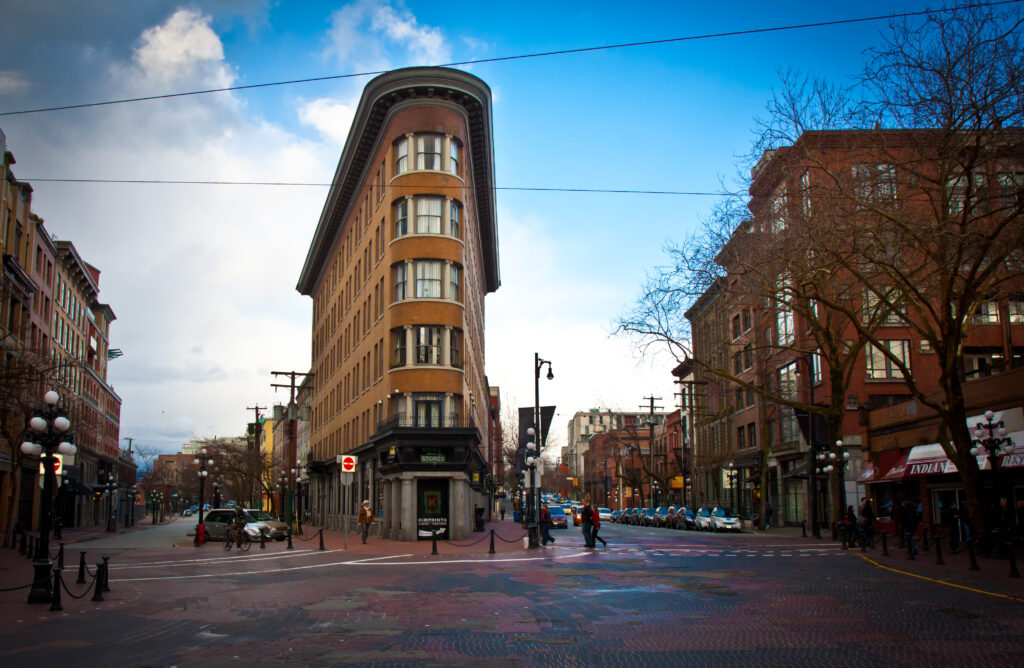
Wikimedia Commons
Built: 1909
Architect: Parr and Fee Architects
Location: 43 Powell (At Alexander)
Architectural Style: Flatiron
An anchor-point in Gastown, the Hotel Europe holds many first-of-its-kind distinctions. Built innovatively on a triangular lot, it was both the first reinforced concrete construction in Canada, and, as a natural extension, the first fireproof building in Western Canada. A welcome feature given Vancouver’s Great Fire that had swept through the area 23 years prior.
Today, Hotel Europe is one of the most photographed and recognizable buildings in Gastown. Its dramatic flatiron shape often draws comparisons to New York’s famous Flatiron Building, making it a favourite stop for visitors, photographers, and architecture lovers. The building also forms the backdrop of Maple Tree Square, one of Vancouver’s most historic intersections, adding to its charm and cultural significance.
Originally an affordable commercial hotel ideally located near the docks in the city’s business centre, it also housed an early Vancouver beer parlour, a common watering hole in post-Prohibition era Vancouver. Of course, there is more to the story. We tell the tale of what did (and didn’t!) go on in the Hotel Europe on our Forbidden Vancouver Tour.
Though no longer a functioning hotel, the building remains a cherished heritage landmark and an essential stop for anyone exploring Gastown’s early history.
8. Chinese Freemasons Building (A Heritage Landmark in Vancouver’s Chinatown)

Wikimedia Commons
Built: 1907
Architect: Original unknown, 1913 alterations by Samuel Buttrey Birds
Location: 5 W Pender (Between Carrall & Abbott)
Architectural Style: Dual Facades – Recessed Balconies on Pender side, Restrained Victorian-Italianate on Carrall side
The curiosity of the Chinese Freemasons Building, sitting on the northwest corner of Carrall and Pender, lies in the different facades depending on what side you’re facing. It’s no optical illusion, but rather a key feature of the building. The Carrall Street side is a traditional commercial style, while the Pender Street side features recessed balconies typical of Chinatown. The exterior has been preserved while the interior was demolished in 1975, a classic Vancouver heritage tale as the heritage movement only preserves exterior features.
This historic building remains a vital symbol of Vancouver’s Chinese community and its rich cultural heritage. Its unique dual facades reflect the blend of commercial functionality and architectural beauty, making it a must-see for heritage enthusiasts, architecture lovers, and visitors exploring Vancouver’s Chinatown. The preserved exterior continues to attract photographers and history buffs, highlighting the city’s commitment to protecting its architectural past.
The building is a key emblem for the Chinese community in Vancouver, standing at the entranceway to Chinatown. It housed the Peking Chop Suey restaurant for many years, and the restaurant’s “ghost sign” can still be seen on the exterior of the building, adding a nostalgic touch to this heritage landmark.
Walking past the Chinese Freemasons Building offers a tangible glimpse into Vancouver’s early 20th-century commercial architecture and the city’s diverse cultural history.
9. Carnegie Library (Historic Victorian-Eclectic Landmark in Downtown Vancouver)

Vancouver Heritage Site Finder
Built: 1903
Architect: Georgia William Grant
Location: 401 Main (Between Hastings & Pender)
Architectural Style: Victorian eclectic
The wayback central branch of the Vancouver Public Library, the Carnegie Branch remains a vital hub for culture and community on the Downtown Eastside. Named for Andrew Carnegie (who has a couple other famous buildings and institutions named after him), one of the richest Americans of his time, its namesake’s opulence and architectural beauty are juxtaposed by its location at the crossroads of the city’s social and political turbulence. A testament to the power of community, it houses a key community centre in the area and democratizes access to arts, culture, and opportunity at a literal key intersection.
The Carnegie Library is one of Vancouver’s most cherished heritage buildings, attracting history buffs, architecture enthusiasts, and community advocates alike. Its Victorian-Eclectic design, with elegant stonework, decorative details, and inviting reading rooms, reflects the architectural trends of the early 20th century while emphasizing the civic importance of public libraries.
Once upon a time in the heart of Vancouver’s downtown core, the library-turned-community centre is still a thriving fulcrum. The Carnegie Library symbolizes the great promise of libraries, as Carnegie himself had hoped, in granting access to education to anyone who walks in its doors.
Today, visitors can explore the library’s preserved exterior, attend community programs, or simply appreciate its role as a cornerstone of Vancouver’s cultural and educational heritage.
10. MacMillan Bloedel Building (Vancouver’s Brutalist Landmark by Arthur Erickson)

West Coast Modern League
Built: 1968
Architect: Arthur Erickson
Location: 1075 W Georgia (Between Burrard & Thurlow)
Architectural Style: Brutalist
The second of two Erickson entries on this list speaks to his impact as a Brutalist architect. The MacMillan Bloedel Building signified a westward expansion for the Downtown core as forestry firm MacMillan Bloedel sought a new head office. A young Arthur Erickson was at the forefront of Vancouver architecture after winning a contest to redesign SFU a few years earlier. A stark and simple building — key features of the Brutalist style Erickson would become known for — there were no decorative features, using the materials themselves to do the legwork. Glass and concrete stand centre-stage on this 27-storey monolith, now officially known as Arthur Erickson Place as a nod to Erickson’s impact on Vancouver architecture and culture.
The MacMillan Bloedel Building remains a significant example of Brutalist architecture in Vancouver, attracting students, architects, and heritage enthusiasts interested in mid-20th-century design. Its minimalist aesthetic, exposed concrete, and bold geometric form demonstrate how function and material can define a city’s skyline. As a key part of Downtown Vancouver’s architectural evolution, it highlights the city’s embrace of modernist principles during a period of rapid growth.
While we lament the Courthouse’s low density and lack of aesthetic unity, the MacMillan Bloedel Building exemplifies Brutalism at its best. Even if it’s still not our favourite style, this is a fine display of its ability to let the raw materials shine.
Though often overlooked in favour of more decorative historic buildings, this monolith is an essential stop for anyone exploring Vancouver’s modern architectural heritage.
11. Marine Building (Vancouver’s Iconic Art Deco Masterpiece)
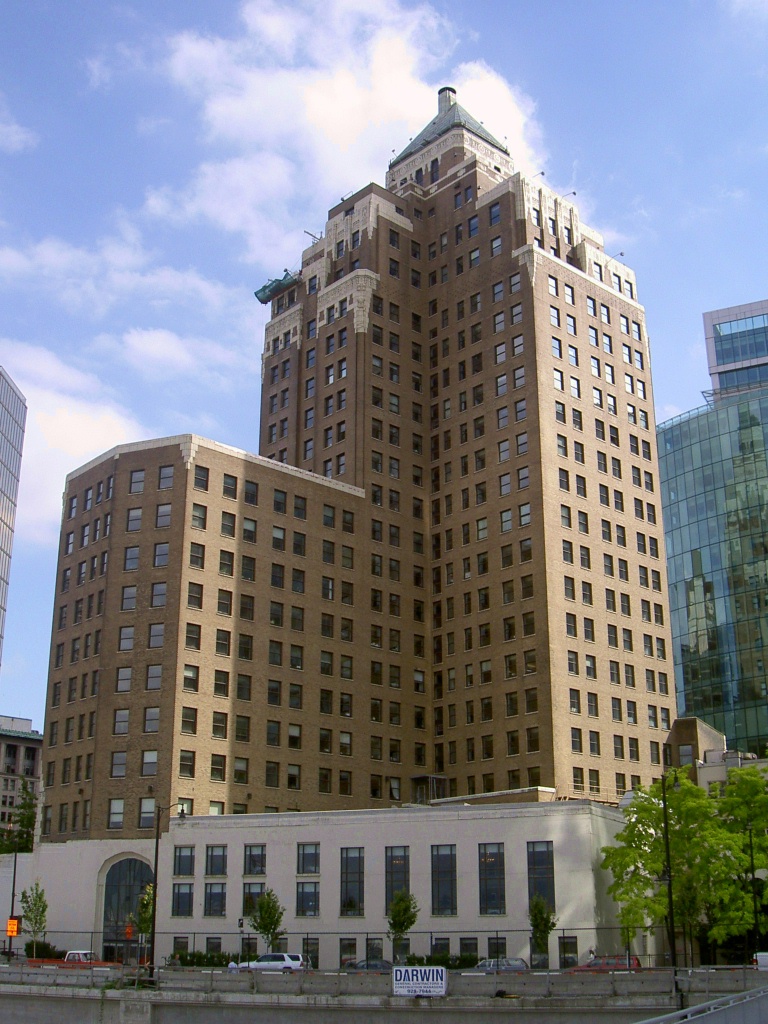
Wikimedia Commons
Built: 1930
Architect: McCarter Nairne and Partners
Location: 355 Burrard (corner of Burrard & Hastings)
Architectural Style: Art Deco
Featuring opulent and intricate marine-themed detail work both inside and outside, the Marine Building is one of the finest examples of Art Deco architecture in the world, right in the heart of Vancouver’s financial district. A commercial building conceived by entrepreneur Joe Hobbes, who saw Vancouver’s potential as a port city, it stood as the tallest building in Vancouver for nearly a decade (once again eclipsed by another entry on this list). It used the same architects as the ill-fated Georgia Medical and Dental Building, so one of their designs still stands tall over Downtown Vancouver.
The Marine Building is celebrated not just for its height but also for its decorative exterior and interior details, including intricate brass, marble, and terra-cotta elements that capture the glamour of the 1930s. Architecture enthusiasts and tourists alike consider it a must-see landmark when exploring Vancouver’s downtown heritage buildings. Its prominent location at Burrard and Hastings makes it a defining feature of the city skyline and a symbol of Vancouver’s commercial history.
Of course, history is a cruel mistress and construction on it was completed just as the Great Depression was hitting critical mass, and so Joe Hobbes was forced to sell to a little-known family business: the Guinnesses.
The Marine Building also serves as the final stop on our Downtown Sinners & Sweets Tour (Holiday History & Hot Chocolate tour for the winter season), giving visitors a chance to peek inside and appreciate its stunning Art Deco interiors up close.
12. Dawson Building (Edwardian Commercial Landmark on Vancouver’s Downtown Eastside)
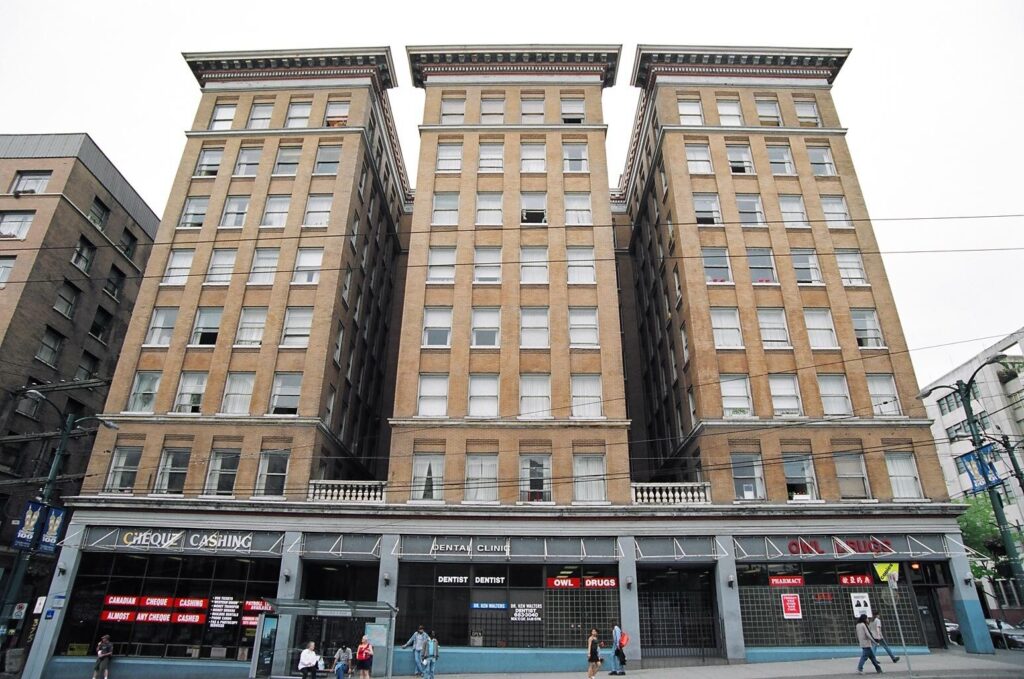
Affordable Housing Society
Built: 1912
Architect: Bedford Davison
Location: 375 Main (Between Hastings & Cordova)
Architectural Style: Edwardian Commercial
A testament to both Vancouver’s growth and social change in the city, the Dawson Building — now officially the Ford Building — was built as a commercial property during a period of rapid expansion. While the downtown core later shifted west, this building remained a key commercial hub on the eastside. Over the years, many businesses have occupied it, with grocers and druggists at street level and offices upstairs for lawyers, doctors, and other professionals. It was also an important hub for Japanese businesses in the 1930s.
The Dawson Building is a classic example of Edwardian Commercial architecture in Vancouver, showcasing the city’s early 20th-century urban development. Its preserved façade, multi-use design, and historic associations make it an important stop for heritage enthusiasts and anyone exploring the architectural history of Vancouver’s Downtown Eastside.
The building was originally named for George Dawson, a canner from New Brunswick who opened a number of canneries in Steveston. Now home to low-income housing units, locals may know it most prominently for the Owl Drugs at street level, a nostalgic reminder of Vancouver’s commercial past.
Walking past the Dawson Building offers a glimpse into Vancouver’s Edwardian-era architecture and its evolution as a centre of commerce, community, and cultural diversity.
13. Vancouver City Hall (Art Deco Heritage Landmark on Cambie Bridge)
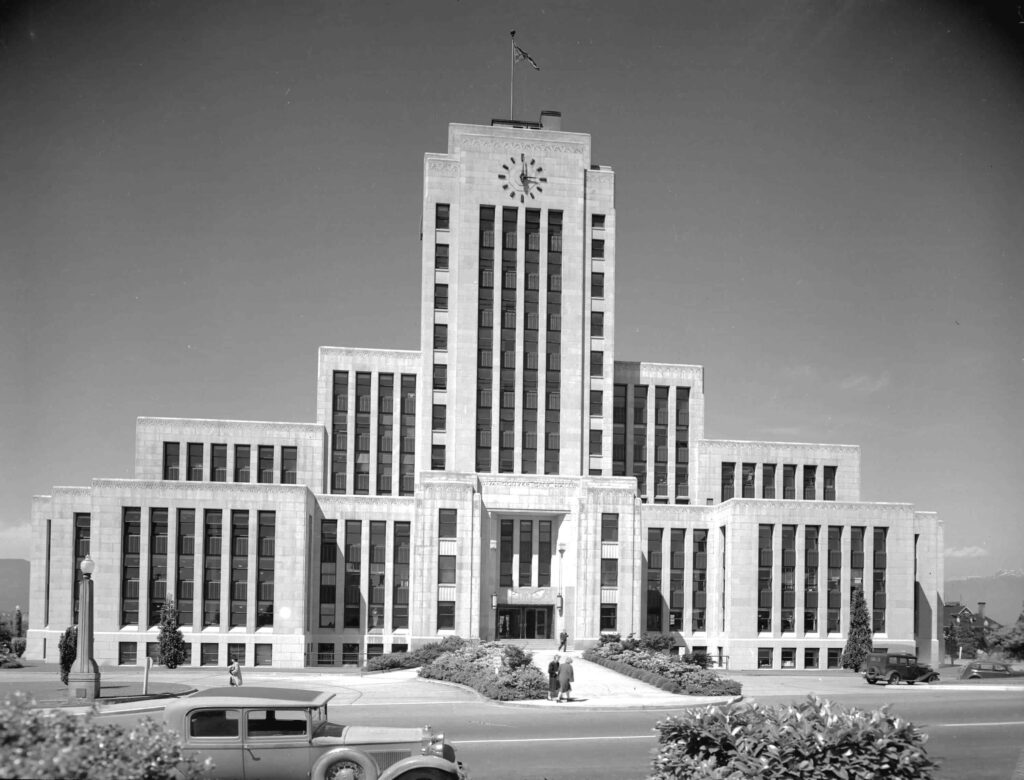
Vancouver Heritage Foundation
Built: 1936
Architect: Fred Townley & Matheson
Location: 453 W 12th (Between Cambie & Yukon)
Architectural Style: Art Deco
Vancouver City Hall is a fascinating product of its time, both in its genesis and in its style and locale on the south side of the Cambie Bridge. The decision to shift city hall outside the Downtown Core was led by then-mayor Gerry McGeer (hear more on him on the Forbidden Vancouver tour) to reflect the City of Vancouver’s recent expansion south and west into Point Grey and South Vancouver. Its architectural style is a direct result of its era, as was its role as a Depression-era make-work project, alongside the Third (and present-day!) Hotel Vancouver and the Lions Gate Bridge.
Vancouver City Hall is a key example of Art Deco civic architecture in Canada, drawing attention for its streamlined forms, geometric detailing, and elegant proportions. Heritage enthusiasts, architecture students, and visitors exploring Vancouver’s historic sites often stop here to admire its design and learn about its place in the city’s development. The building’s location and style also reflect early 20th-century urban planning trends and Vancouver’s expansion beyond its original downtown core.
Vancouver’s fourth city hall, it received heritage designation in 1976. The interior is remarkably unchanged, and the exterior is marked by a statue of the city’s namesake, Captain George Vancouver (who didn’t actually name the city, but that’s another story — or one you can hear about on our Lost Souls of Gastown Tour).
City Hall remains an active civic building while serving as a historic landmark, allowing visitors to appreciate both its ongoing function and its contribution to Vancouver’s architectural heritage.
14. Vancouver Public Library Central Branch (Moshe Safdie’s Roman Coliseum-Inspired Landmark)

Cultural Landscape Foundation
Built: 1995
Architect: Moshe Safdie and DA Architects
Location: 350 W Georgia (between Homer and Hamilton)
Architectural Style: Roman Colosseum
On the eastern tip of Vancouver’s Downtown Core, the VPL Central Branch draws clear inspiration from the Roman Colosseum, albeit about 2,000 years its junior. Boasting a collection of nearly 10 million volumes, including digital media, it opened in 1995 to replace the previous Burrard branch (formerly the site of the Victoria’s Secret-turned-Adidas store). Its design was the result of a public contest won by Moshe Safdie, who created a scale model of Library Square to gain overwhelming public support. Safdie envisioned the VPL as “a great gathering place in the city,” encouraging visitors to meet, socialize, and enjoy the library environment.
The VPL Central Branch is not only an architectural marvel but also a cornerstone of Vancouver’s cultural and educational life. Its Roman Colosseum-inspired design, spacious reading rooms, and integrated public spaces make it a must-see for architecture enthusiasts, history buffs, and tourists exploring Downtown Vancouver. The library’s thoughtful design fosters community engagement while showcasing modern interpretations of classical architecture.
Until about a decade ago, the top two floors were leased for government use. When this ended, Vancouver’s best-kept secret emerged: the VPL Rooftop Garden, offering stunning eastward views and a rare free Vancouver rooftop experience. It’s the perfect spot to enjoy a coffee or a light meal while taking in the cityscape. For the author of this post, it rounds out the list as her favourite spot in Vancouver.
Whether you’re exploring the library’s architecture, attending public programs, or enjoying the rooftop garden, the VPL Central Branch represents one of the city’s most significant modern heritage landmarks.
Frequently Asked Questions
1. What are the most famous heritage buildings in Vancouver?
Some of the most famous include the Marine Building, Hotel Vancouver, Dominion Building, Sun Tower, and City Hall.
2. How many heritage buildings does Vancouver have?
Vancouver has more than 2,200 registered or protected heritage buildings across the city.
3. Can you visit heritage buildings in Vancouver?
Yes. Many buildings such as the Vancouver Public Library, Hotel Vancouver, and Marine Building have publicly accessible areas.
4. What architectural styles are common in Vancouver’s historic buildings?
Art Deco, Beaux-Arts, Edwardian Commercial, Post-Modern, Second Empire, and Brutalism.
5. What is the oldest heritage building in Vancouver?
Some of the oldest include the Carnegie Library (1903) and Hotel Europe (1909). Other older buildings exist, primarily in Gastown and Chinatown, that date back to the 1880s and 1890s.
6. Are Vancouver’s heritage buildings protected by law?
Many are protected under the Vancouver Heritage Register or designated under the BC Heritage Conservation Act, which helps prevent major alterations or demolition.
7. Can you take guided tours of heritage buildings in Vancouver?
Absolutely. Several organizations—including Forbidden Vancouver Walking Tours and the Vancouver Heritage Foundation—offer guided tours that explore the history and architecture of key buildings.
8. Are any heritage buildings in Vancouver rumored to be haunted?
Yes! Sites like the Vancouver Police Museum, Hotel Vancouver’s 14th floor, and the Old Courthouse have well-known ghost stories linked to them.
9. Do heritage buildings in Vancouver get renovated or restored?
Yes. Many undergo restoration to preserve their historic character while updating interiors for modern use—for example, the Sinclair Centre and the Woodward’s redevelopment.
10. Why are so many heritage buildings clustered around Gastown?
Gastown is the city’s birthplace and one of the oldest neighborhoods, so it naturally contains many of the city’s oldest buildings.
11. Are there any free places to explore Vancouver’s heritage?
The outside of the Marine Building, Victory Square, the Steam Clock area, and the Water Street corridor in Gastown can all be enjoyed freely.
12. What makes the Marine Building so iconic?
Its ornate Art Deco design, nautical details, grand brass doors, and Hollywood film appearances make it one of Vancouver’s most recognizable architectural treasures.
 Rachel Ruecker is a performer and writer from Vancouver but currently based in Halifax, but cherishes any chance to write about her hometown and what makes it so special. She performs stand-up comedy and loves telling stories and building community through laughter. She is currently pursuing her masters in writing!


